The 1-dimensional hydrodynamic-biogeochemical model GOTM-FABM-SELMA-Protbas is in the final stages of calibration, and shows good results for temperature, chlorophyll and phosphorus.
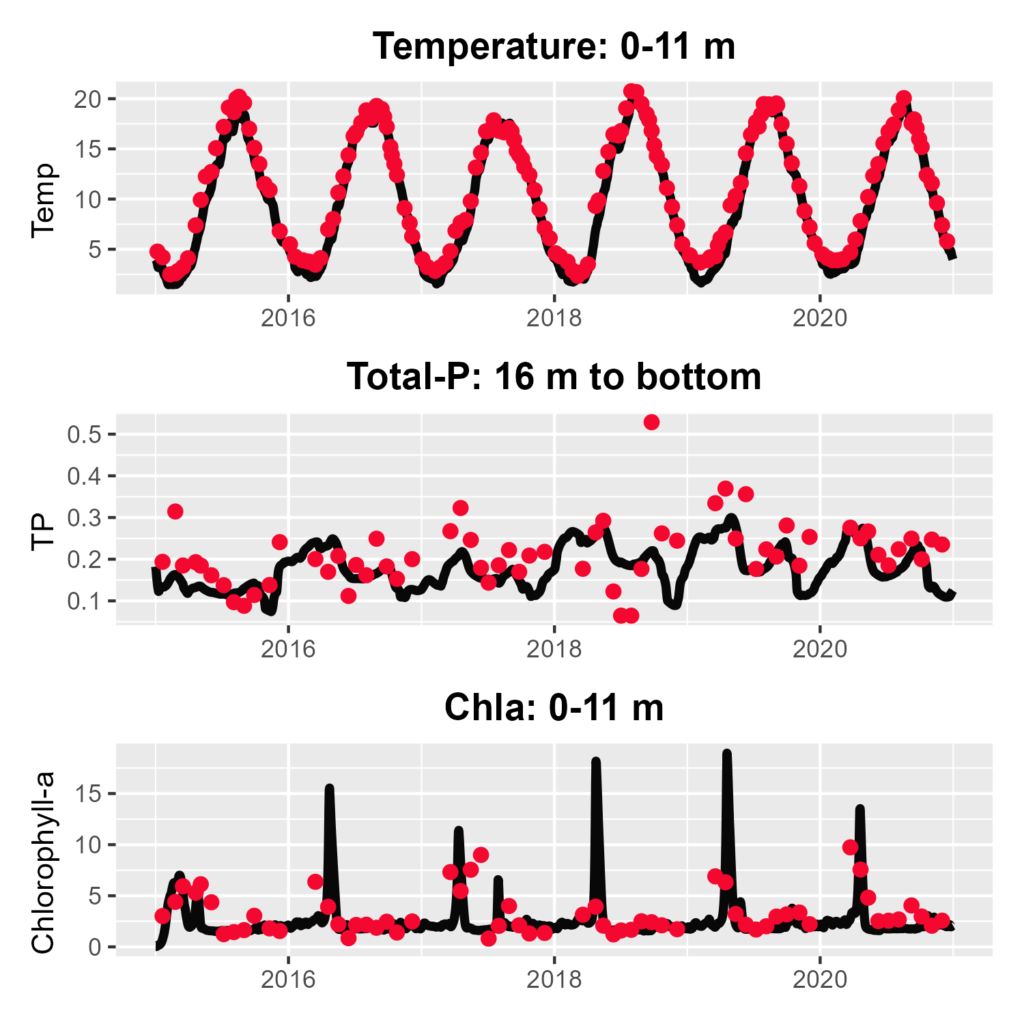
The 1-dimensional hydrodynamic-biogeochemical model GOTM-FABM-SELMA-Protbas is in the final stages of calibration, and shows good results for temperature, chlorophyll and phosphorus.
Between April 2024 and July 2025 the German team measured water temperature of the water column at the dam wall, and of the inflows at the surface water of the predams. In parallel, we also measured the current velocities using two ADCPs (acoustic current doppler profilers) at two points in the reservoir. The temperature measurements showed high frequency and small scale patterns in the reservoir stratification, and showed that the temperature of the inflows is up to 10 degrees (Celsius) colder than the surface water of the reservoir in summer. This means that inflows likely plunge and flow along the thermocline.
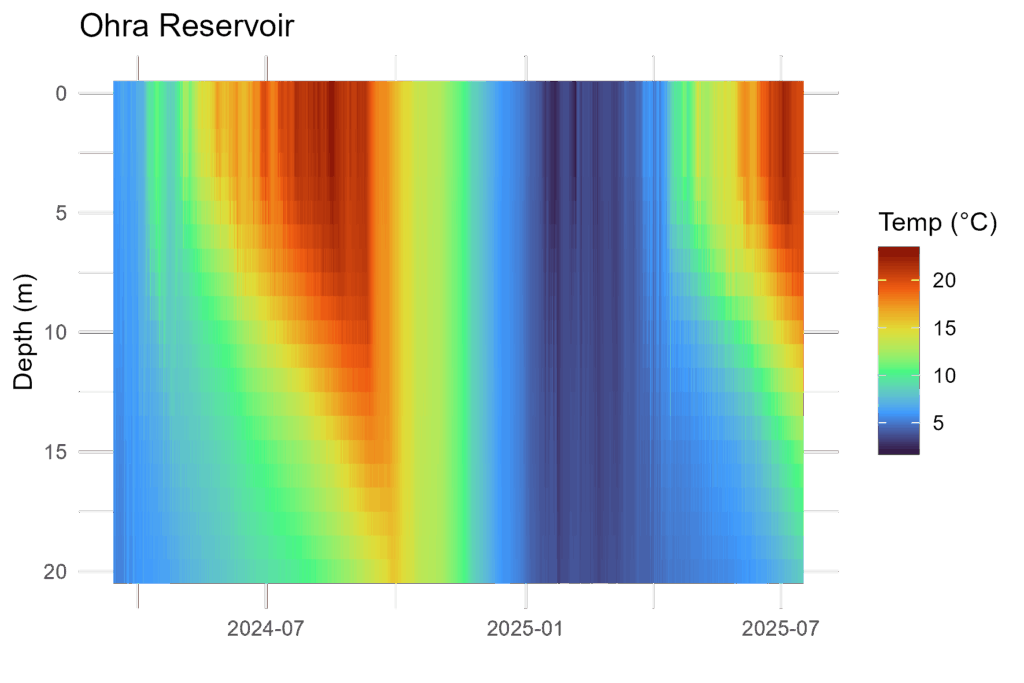
Heatmap of water temperature at the deepest point of the main reservoir, near the dam wall.
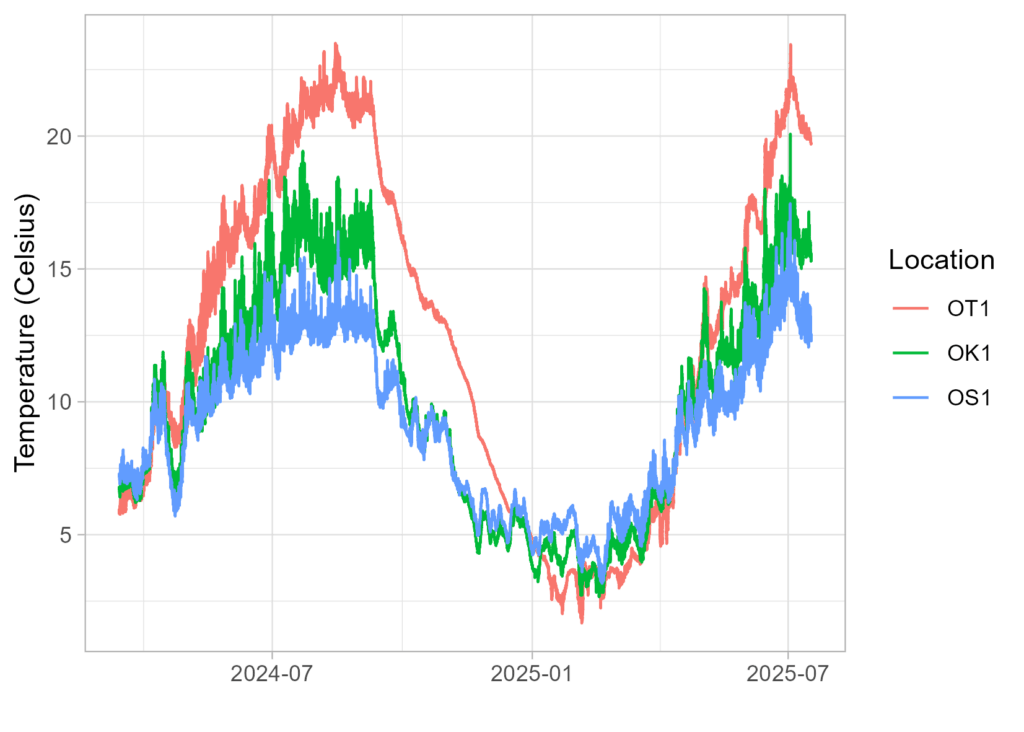
Comparison of the surface temperature at the main reservoir (OT1) and the two inflows at the predams (Kernwasser OK1, and SIlbergraben OS1).
One of the key concerns raised by our main stakeholder, the Israel Water Authority (IWA), is the occurrence and dynamics of cyanobacterial blooms. These blooms, often involving nitrogen-fixing species, can degrade water quality and pose public health risks.
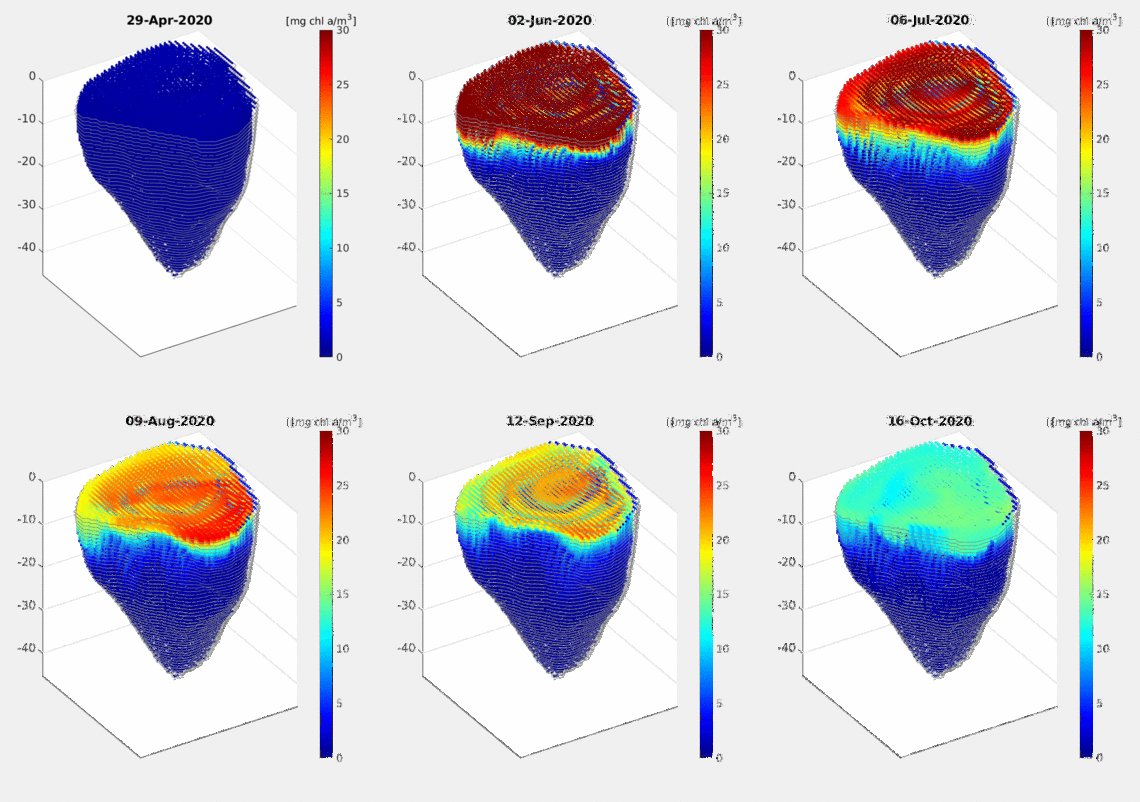
To better understand these processes, we used the preliminary FABM-SELMA ecological model together with pyGETM to simulate the springtime dynamics of nitrogen-fixing cyanobacteria in Lake Kinneret.
The animation below illustrates the 3D development and movement of the bloom, providing insights into how environmental drivers such as nutrient inputs, temperature, and circulation influence its evolution.
We have now completed full calibration of all the hydrology models that will be used to simulate the water inflows to Lake Mälaren. More information can be found here.

One of the tests that we are currently doing with the Mälaren PyGETM model is to add tracers to the inflows. This serves partially as a proof-of-concept (is the model working correctly?), but also visualises preferential flow paths and an indication of how fast particles spread throughout the lake.
In this short animation, you can see how a tracer (with a fixed concentration of 1.0 mol/m3 in the inflows and an initial concentration of 0.0 mol/m3 in the lake) spreads through Mälaren over a period of 6 months.